

Slow Rebellion
on the power of slowness in a world on fire

Welcome to Slow Folk - a community for gentle hearts and rebellious creatives, thirsty for a slower life in a world obsessed with speed.
Welcome to the Unbusy Revolution.
Back at my writing desk. It’s been while. Honestly, I dunno about you, but I’ve found it a struggle to write about anything of late. Even my weekly Fresh Sheet to my farm customers. It’s usually a breezy thing written dark and early over my Tuesday morning coffee. Instead, it’s been like trying to pluck some shiny, clear stone out of a sticky pool of tar.
The darkness of our moment gets stuck to it and I can’t scrub it off.
For two nearly two years now, each time I sit down to my desk, all my fingers want to peck out on my keyboard is ceasefire.
What does it mean to live slowly when the world is on fire?
I think, maybe, that if we only view slowness through the lens of how it’s framed on social media - aesthetic and superficial - it might feel like frivolous self-indulgence.
But what if slowness in dark times could be an act of defiance? A lighting of a candle? An outstretched hand? A joyful act of rebellion? What if slowness in our moment isn’t an indulgence, but an essential morsel of communal sustenance?
Stay with me.
What if slowness isn’t actually about living the trad-wife life or buying the perfect modern farmhouse or moving to some lovely cottage in the English countryside. What if the core of slowness - radical slowness - is about being present to our lives in a world consumed by distraction? What if that attention, that focus, that full and luxurious embodiment of our own flesh and blood . . . What if that intentional movement through the world, eyes and hearts open, is exactly what our time urgently calls out for?
What if connection to our places and the people who live in them - real, genuine, human communion - not that pathetic excuse for connection sold by the snake-oil salesmen of Silicone Valley . . . what if that holds the seeds of our collective path out and through?

What if making space to be present, to pay attention, could be an intentional act of loving rebellion in a world on fire?
I saw a video by Anglea of Parkrose Permaculture out of Portland recently that underscored this for me.
Angela shared how a friend had gently challenged her as to whether her work on social media was really the best use of her energy. Sometime after that conversation, Angela was at a protest. She stopped to help an elderly lady. As they walked and the older woman shared her story, Angela came to realize this woman was one of her neighbours. The old woman was struggling, collecting bottles to pay her rent.
The juxtaposition of these two moments clearly caught Angela off-guard. Here she was, fighting the good fight in the nebulous world of social media, when literally right next to her, someone needed her help in an immediate, human, concrete way. Angela’s work online is important - as a Canadian, I watch her updates about the plight of MY neighbours to the south - but I think her intuition was right in questioning if this is, indeed, the best use of her precious, finite attention.

That act of questioning, that pause to ask ourselves with grace, curiosity and compassion - Is this my highest point of contribution? THAT is slowness as rebellion.
When the world is on fire, we have to ask ourselves, Who profits?
Who benefits from the chaos, the bloodshed, the tearing of a democracy apart, limb-by-deliberate-limb - the way the creepy kid of the neighbourhood would meticulously, mirthfully, coldly dismantle some poor bug beneath a magnifying glass in the back lane?
So when Google signs a $45 million dollar ad campaign with Israel to deny the genocide unfolding before our eyes, we shouldn’t be surprised. The same folks who benefit from our distraction are benefiting from some of the worst human suffering many of us have ever witnessed. These same folks profit when we lose ourselves in our rage and distraction, screaming into the abyss of those tiny blue screens in our pockets, instead of lifting our eyes and our hands to the world around us.
Tuning into the real world, the one of flesh and blood and humanity, this is a radical act of slow defiance. We cannot be both places at once. In turning our faces towards the sun and the eyes of our neighbours, we cannot also be captured by the machine behind our screens.
Choosing one necessitates saying NO to the other.
So what might slow rebellion look like? What concrete steps might we take in our daily lives to fight back against the darkness?
1. Become a living reservoir of resources
As I move into middle age and beyond, this idea has become core to my purpose. It might sound ridiculous, but as we move through this time, I am coming to realize why they burned women like us at the stake. And I wonder if maybe, being that kind of woman is something to aspire to; to become an old woman who represents a reservoir of wisdom for my community.
Many of us no longer know how to provide the basic sustenance of life for ourselves. We don’t know how to mend a wound, save seeds, put food by for winter. Many of us don’t even know how to cook.
Learning some simple, life-affirming skills is a bulwark against both tyranny and hunger. Once you know how to grow tomatoes or catch a fish or set a lamb’s leg - no one can legislate that knowledge away from you. It is yours to keep. There is a deep, immovable power there.
Choose something that interests you and get curious. Learn. Try and fail. Be willing to suck before you gain mastery. You don’t need to buy a farm and move to the country. A pot of herbs on a windowsill counts. When we look at this from a community perspective, every tiny drop of knowledge matters.

2. Embrace the idea of mutual aid
All that knowledge does no one much good if we aren’t willing to share it.
One of the things that struck me when we first moved to the farm, was how long it took for help to come. When our power goes out, it isn’t for an hour or two. It might be days - sometimes many. But the funny thing is, that knowledge - that no one is coming - it engenders community in the most beautiful way.
So one Christmas when a horrible ice storm struck our region and city folks were hollering about rotting food in the fridge and the slow reaction of officials - our community was tucked tight and warm. The moment the storm stopped, the neighbours streamed outdoors and the sound of chainsaws and heavy equipment filled the air. The elderly and ones without fires or generators were checked on, supplies appeared, driveways were cleared.
The same thing happened when we were ravaged by devastating floods. I think, despite what we’re told, is that this is the rule, not the exception. When the sky falls, humanity shows up.
Think of ways that you can help. What skills could you gain that would be a net positive for your community? First aid? Traditional medicine? Gardening? Organizing? Legal support? Fundraising? Building community connections?
It doesn’t really matter what it is. Just that it is.
Be a lamp. Be a lifeboat. Be a ladder. - Rumi
3. Get to know your neighbours
I know, I know. I recommend this all the time and I always get a boatload of excuses why this isn’t possible. I’m sorry, but that’s exactly what it is. Excuses.
I have lived in the heart of one of Canada’s largest cities. I’ve lived in the suburbs. I’ve lived in the colourful haunts of urban East Van and now out here in the rural Fraser Valley. In each and every one of those (very different) locations, I have gotten to know my neighbours. In fact - I even married one.
I think the trouble here is, we tend to confuse something being uncomfortable with something being not possible. We tell ourselves we can’t because we don’t want to endure the discomfort or expend the effort necessary to build community.
If I had a dollar for every mama who wrote to me asking where that dang village is she was promised . . . Girl. Building community takes WORK. It means putting yourself out there. You’ve gotta recognize that what you’re trying to do is now, sadly, outside our social norms. That means folks won’t be sure how to react and you’re gonna get a lot of rejection.
It will feel super uncomfortable letting folks all up in your business. There are costs to community. You’ve gotta show up when you don’t feel like it. You have to make space for folks with whom you aren’t perfectly ‘aligned’. In fact, you will probably have to give up your ideas about alignment altogether. Burn ‘em down.
Recognize that this idea of ‘alignment’ is one of the tools that those profiting from chaos use intentionally to keep us fighting amongst ourselves, instead of looking up for the true source of our problems.
Many of my neighbours are very different from me. We don’t think the same about many important issues. We are from different generations, different ethnic backgrounds, different religions, different political tribes. We also love and respect one another. We need to relearn how to agree to disagree and to instead search for those human connections that actually matter; generosity, mutual aid, kindness, curiosity, love.

4. Read
Read. Read everything you can. Read banned books, books by people you disagree with. Read history books and great works of literature. Read poetry. Read philosophy. Read religious texts. Read it all.
Reading is one of the greatest quiet acts of slow rebellion we can undertake. It forces us to embody slowness in a granular, immediate, temporal way. To be in our bodies with our thoughts, without the comfort of the escape hatch of distraction. This, in and of itself, is valuable practice.
Reading history arms us against tyranny. History might not repeat, but it sure does rhyme. Reading helps us to recognize patterns as they unfold in real time. It can also function as a compass towards the way out and through.
Reading helps us keep our ability to think. The more we use AI and all the rest, the less our brains will be able to navigate our rapidly shifting and often dangerous world. Reading combats that trend towards atrophy.
(Not to mention, an educated public is our best defence against tyrants.)
Reading literature builds empathy, helps us see the world through someone else’s eyes - a skill sorely lacking in our current culture. Historical lit, for me, is also a powerful reminder that we have - collectively - survived dark days before.
And poetry and the rest? Well, it reminds us why life is worth fighting for. Anytime I feel despair creeping in, I pick up an anthology of Mary Oliver’s poetry or Rumi or Hafiz.
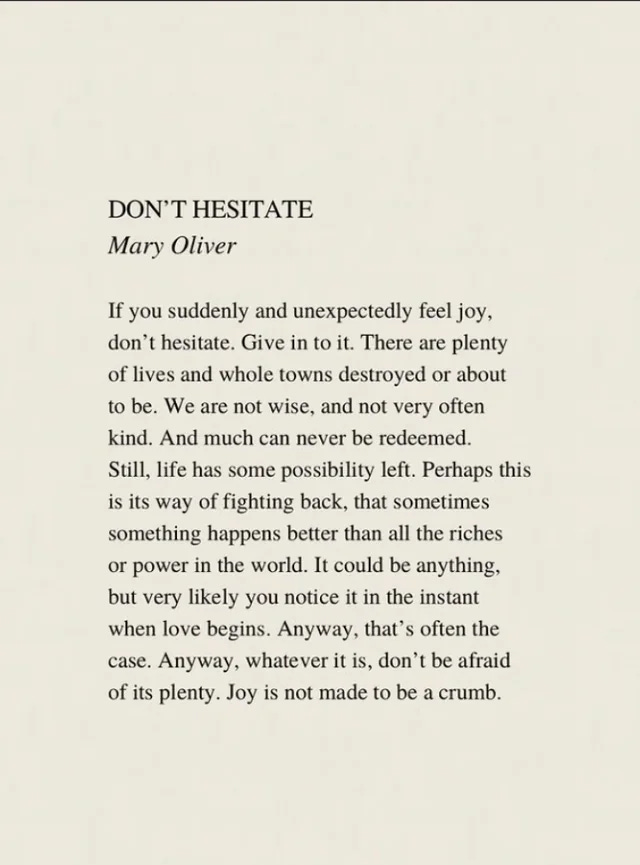
Even in the darkest days, there is still beauty to be found, everywhere.
5. Live within your circle of influence
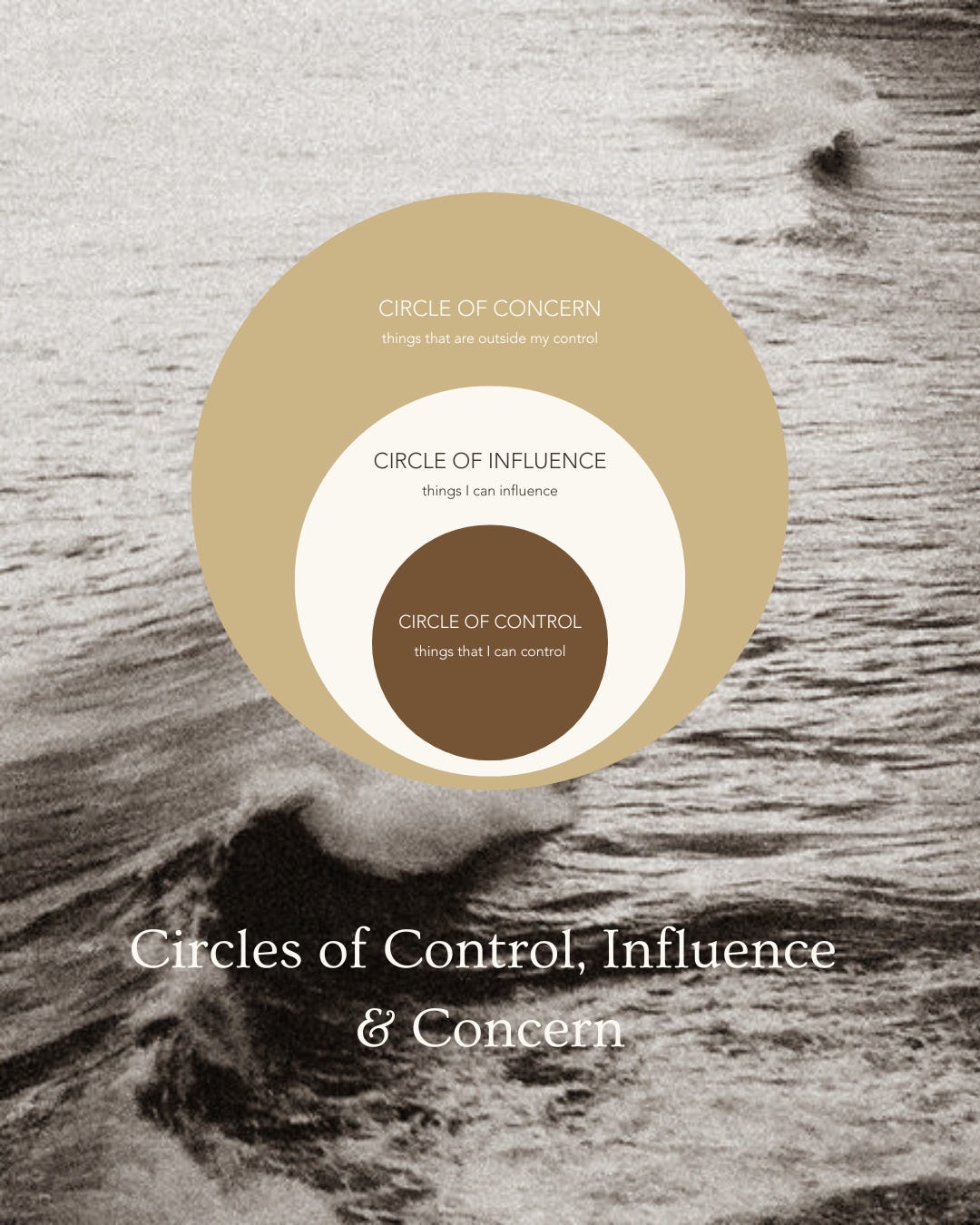
Gosh, if there has been one slow habit that has transformed my life more than any other, it’s this. This one originated with Stephen Covey in his timeless book, The Seven Habits of Highly Effective People. I return to this whenever I feel unmoored or overwhelmed or helpless.
When our community was struck by a devastating flood, I felt helpless. As the emergency ground on, I needed to DO something. I turned to my hubby and said, These poor families, it’s almost Christmas - What are they going to do?? If we can’t figure out how to make sure just one of them gets a Christmas dinner, then there is something wrong with us.
I was prepared to just figure it out myself. But instead, I put it out to my farm customers. I let them know what I was doing, and invited them to join me. I set out to find a family who had been impacted and put out the word. That act - of insisting on living within my circle of influence - setting out to feed just one family dinner . . . well.
Turns out, when I tucked into my circle of influence with intention, it ended up being much, much larger than I knew! In just two short weeks, my farm folks showed up in force. We raised over $5000 cash and my house filled with gifts and food for not one, but two large families.
I haven’t seen those folks before or since, but we showed up for them when they needed us. That’s what can happen when we choose to take action within our circle of influence; it grows.
When we doom scroll, we’re living in our circle of concern, usually far outside of our circle of influence. In short, it’s not productive. Slowing down and asking ourselves what we can actually DO is a powerful act of defiance against despair. It doesn’t need to be earth shattering. Sometimes something as simple as smiling and saying good morning to a stranger is all we need to pull ourselves from the grip of hopelessness.
And sometimes, just a nudge in the right direction is all we need to keep going.
In hope and solidarity -


Stacey Langford is a writer, renegade farmer and slow business mentor living and working in Canada’s Fraser Valley. In 2010 Stacey ditched her cubicle in the city to turn her attention homeward, farm and help others craft a simple life, from scratch.
This was beautiful Stacey! And I refer back to the circle of concern a lot in my work witn students. What can you actually do and have influence. The rest you have to leave to one side
Love your writing ...... "pluck some shiny, clear stone out of a sticky pool of tar."
.... and nice to have a contrast in seasons, with Aussies heading into spring